Published October 8, 2026
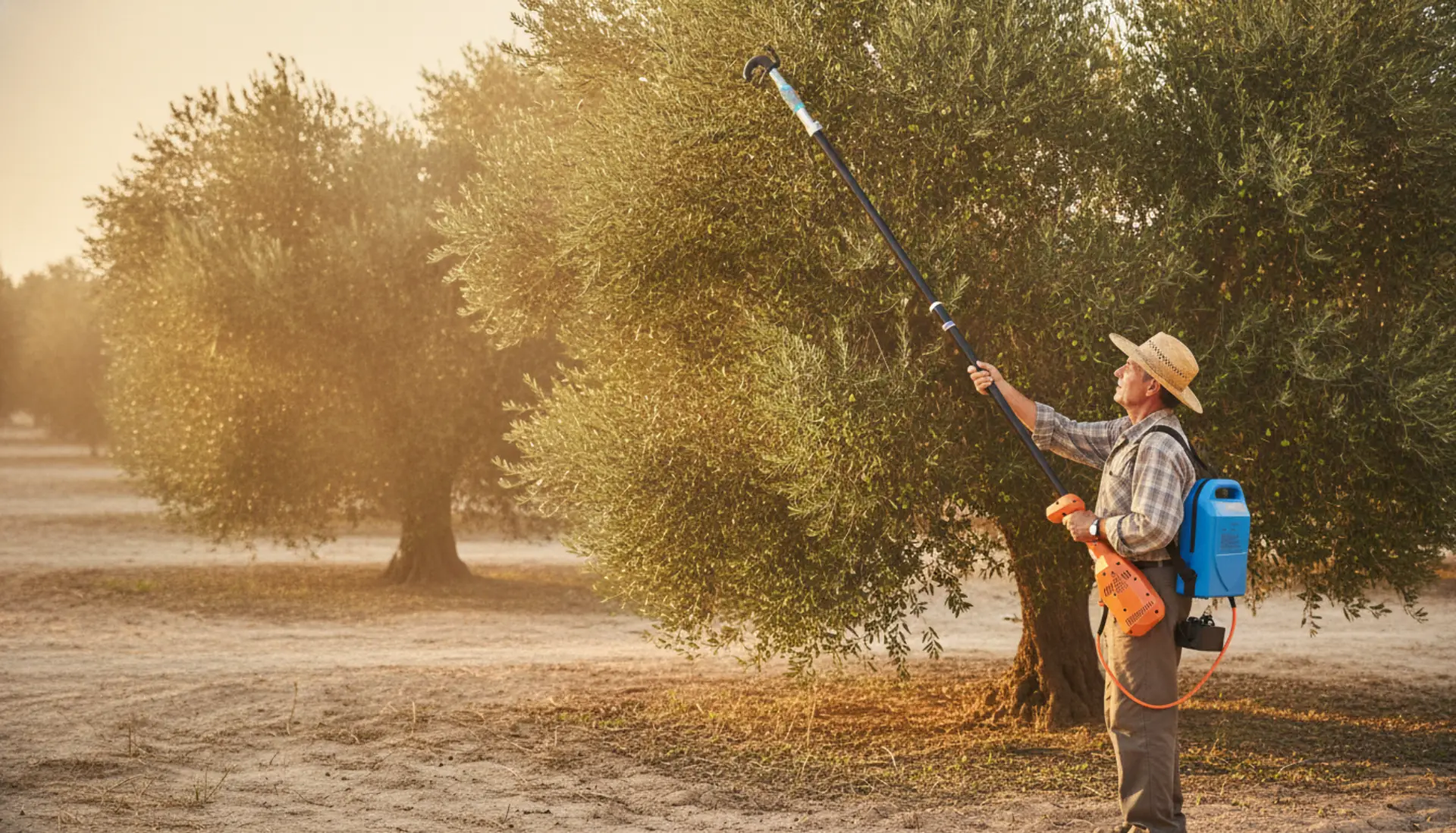
battery sea buckthorn harvester cold weather pole reach
Learn how 24V lithium battery shakers and adjustable frequency controls harvest frozen sea buckthorn down to minus twenty degrees Celsius.

Traditional manual harvesting breaks down in winter sea buckthorn groves because berries freeze solid onto dense, thorn-covered branches that tear gloves and skin. Workers slow to a crawl when temperatures drop below freezing, making hand-picking economically unviable for orchards trying to clear hundreds of trees before spring thaws the fruit. Portable battery-powered harvesters solve this bottleneck by replacing human fingers with controlled mechanical vibration, but standard consumer tools fail when exposed to sub-zero orchard work.
- Why frozen berry clusters and thorns defeat manual harvest crews
- How sub-zero operating temperatures dictate the seasonal harvest window
- Adjusting vibration frequency to strip fruit without splintering brittle wood
- Pole reach specifications for dense shrub canopies
- Low-temperature lithium battery performance at minus twenty degrees Celsius
Why Winter Conditions and Thorny Canopies Stop Hand Harvesting
Sea buckthorn branches feature sharp, rigid thorns that turn manual picking into slow, painful labor. As berries freeze solid on the wood, they fuse tightly to the branch structure. Workers using traditional methods can barely harvest a few kilograms per hour before hand fatigue and torn protective gear force them to stop. This manual bottleneck accounts for fifty to seventy percent of total production costs on family-run farms, leaving growers searching for mechanical alternatives that can operate in harsh winter conditions without destroying the crop.
The Role of Sub-Zero Operating Temperatures in Seasonal Windows
Seabuckthorn shrubs possess extreme cold hardiness, surviving winter temperatures down to minus forty degrees Celsius as noted by the Ontario Ministry of Agriculture, Food and Rural Affairs. Commercial growers rely on sub-zero winter temperatures to freeze the high-moisture berries so they detach cleanly from the branch without bursting. Research published by the ScabePub organization highlights that daily maximum temperatures around minus fifteen degrees Celsius and minimums hitting minus thirty degrees Celsius render frozen wood exceptionally brittle. This frozen state is essential for mechanical detachment, but it requires specialized equipment built to withstand extreme cold without draining power or seizing mechanical joints.

Frequency Tuning for Tight Fruit Clusters and Branch Integrity
When ambient temperatures drop below zero, unmanaged shaking frequencies easily shatter frozen branches before the fruit drops. Research from ScabePub warns that rigid wood shaken at a fixed twenty-five hertz can break during the initial cycles. KuaiYiDe addresses this by building adjustable frequency controls into their harvesting heads. Operators adjust the vibration from zero to four thousand times per minute on the B Series enhanced electric harvester to match the exact ripeness and brittleness of the crop. This fine-tuned vibration amplitude, ranging from twenty to fifty millimeters, transmits enough kinetic energy to strip dense clusters while preserving the structural integrity of the underlying branch.
Pole Reach and Maneuverability in Dense Shrub Canopies
Mature seabuckthorn plants form dense, tangled thickets that reach heights between two and five and a half meters, according to data from the Ontario Ministry of Agriculture, Food and Rural Affairs. Commercial cultivation systems usually maintain pruned heights between one and a half and two and a half meters to keep fruit within reach. The A Series portable picker provides a fixed 1.1-meter high-strength aluminum pole for low shrubs, while the B Series offers modular lengths of 1.1, 1.4, and 1.8 meters to clear heavier growth. This extended reach allows a single operator to target upper canopy clusters directly, bypassing the physical barrier of lower thorns and eliminating the need for dangerous ladder work in icy orchard aisles.

Sustaining Performance at Minus Twenty Degrees Celsius
Standard lithium-ion battery packs lose charge rapidly and struggle to deliver peak output when ambient temperatures drop below freezing. KuaiYiDe equips its harvesting machines with a 24V lithium battery system rated for operations down to minus twenty degrees Celsius. The A Series uses a 300W brushless motor, while the B Series steps up to a 600W high-power brushless motor designed to maintain high torque against frozen fruit clusters. Rated for ten to twelve hours of operation on a single charge, these 30AH battery packs provide stable cordless power in remote northern orchards where petrol engines are hard to start in sub-zero weather. You can review the complete machine lineup and power configurations directly on the machines overview.
Factory Support and Spare Parts for Cold-Weather Operation
Continuous winter harvesting places high stress on mechanical joints, motor housings, and quick-change claw heads. The factory supplies a full range of replacement spare parts to support multi-year field operations, backing each A, B, and C series machine with a standard twelve-month warranty from the date of shipment. Every unit undergoes strict pre-shipment power testing, vibration testing, and safety inspections before leaving the production line to ensure compliance with national standards. When maintenance questions arise during the short harvest window, technical documentation, video guidance, and remote troubleshooting are available directly through the factory support team. You can check the available service items and replacement components on the spare parts page.
Sources
- Sea buckthorn branch shakers operating at frequencies around 25 Hz risk breaking brittle branches when ambient temperatures drop to extreme sub-zero levels like minus 15 to minus 30 degrees Celsius.
- Sea buckthorn shrubs reach maturity heights between 2 and 5.5 meters, necessitating specialized pole reach or commercial pruning to maintain optimal collection heights.
- Commercial sea buckthorn cultivation systems target structured pruning heights between 1.5 and 2.5 meters to align with efficient manual or mechanical harvesting windows.
- Sea buckthorn shrubs exhibit extreme cold hardiness, surviving winter temperatures as low as minus 40 degrees Celsius.
- Maintaining processing and handling temperatures at or below minus 18 degrees Celsius is required to prevent frozen berries and adhering leaves from sticking together during post-harvest cleaning.
- Handheld electric agricultural shakers leverage lithium-ion battery architectures spanning 20V to 40V to deliver high-torque, cordless operation in cold orchard environments.